Reading Bewley's Window
A cultural palimpsest in stained glass. Harry Clarke's 1927 windows at Bewley's, Grafton Street, Dublin, read one motif at a time — where an imperial column becomes a vehicle for Gaelic encoding.
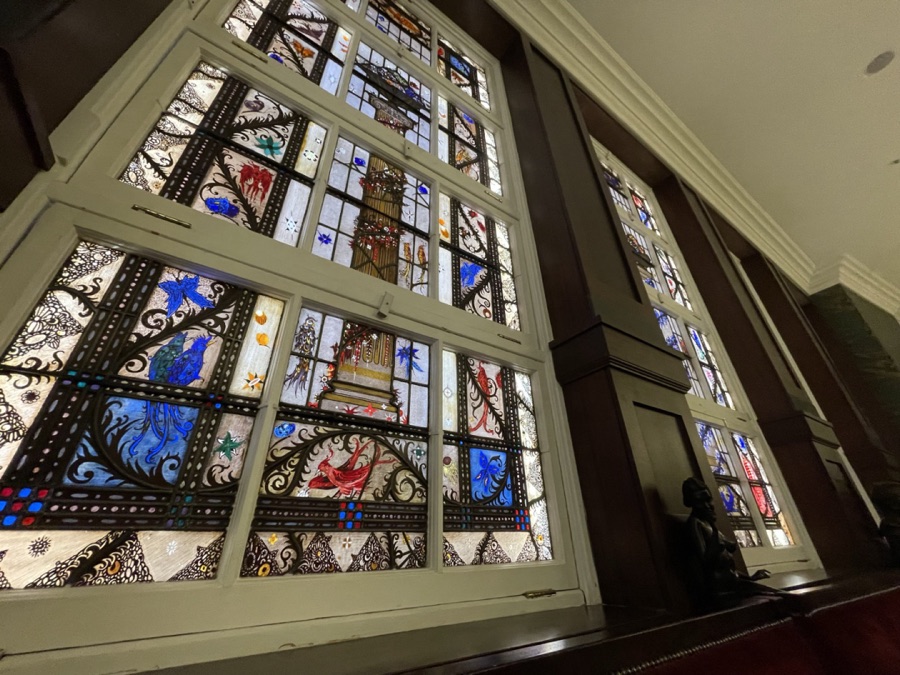
Markers 1–7 follow a top-to-bottom reading path and point to regions where each motif type appears — not to single identified figures. Hover or tap to read one region through five cultural lenses. This oblique photograph shows only part of the window, so some readings also draw on published descriptions. The photograph is real; the annotation is an original diagram by the author.
A second window, same café
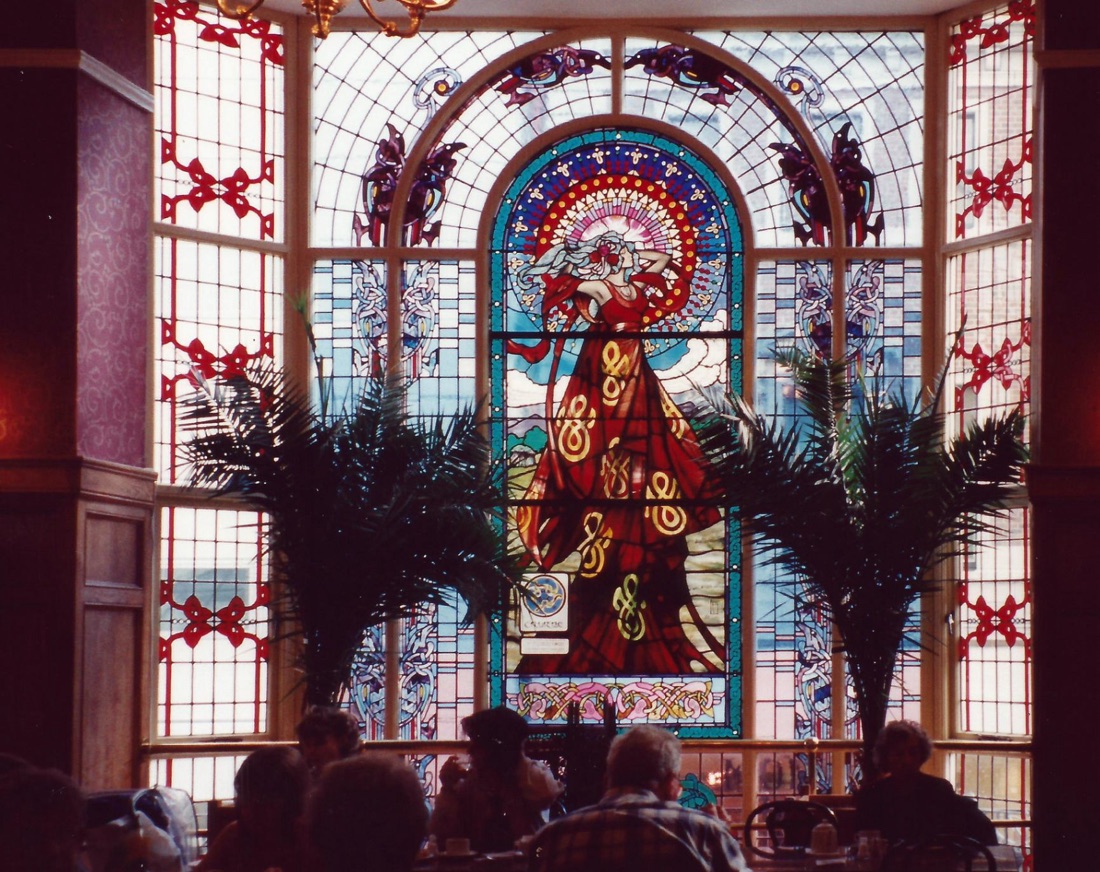
The same room holds more than the Four Orders. This figure window shows how Clarke staged a saint-like presence inside the everyday café — the sacred absorbed into the secular commercial interior.
A window is a palimpsest
No single layer explains the window. Five strata are laid over one another and cannot be peeled apart cleanly — which is precisely the point.
1 · Facade
Egyptianising mosaic frontage — a colonial visual grammar borrowed from empire.
2 · Classical
Four Greco-Roman orders (Doric, Ionic, Corinthian, Composite) frame the panes.
3 · Celtic
Native foliage, birds and butterflies are smuggled into the imperial frame.
4 · Literary
A "third space" of Dublin café culture — Joyce's city of loitering readers.
5 · Heritage
2022 High Court: are the windows fixtures or removable art? Value ≈ €1m.
Provenance & terminology
Visual sources. The Four Orders photograph is by the author (Marco Zexun Zhang), used here under his own copyright. The figure-window photograph is from Wikimedia Commons under CC BY-SA 4.0; the Commons file page is the authoritative record for the photographer's name and the full licence terms. That credit has not yet been independently verified, so the image is not reused in any other experiment on this site. The overlay annotation is an original hand-drawn diagram by the author; it is an interpretive reconstruction, not a facsimile of Clarke's windows.
On "Indigenous". Capital-I Indigenous is not standard terminology for Irish Studies. The relevant contrast here is Gaelic / pre-Norman "golden age" versus colonial. The windows are read as Gaelic encoding working inside a colonial visual syntax — the two are inseparable, which is why the palimpsest model fits better than any single "origin" claim.
Why no AI-generated "Clarke-style" art. Text-to-image cannot faithfully reproduce one specific historical artist's specific window; generated pastiches diverge sharply from the originals. Fidelity is preserved by reading the real photographs, not by imitating them.