Met Collection · Case study
The colour signature of 220 Chinese paintings
What can image features tell us about a collection? Analysed by colour alone, 220 Chinese paintings from the Met's open data sort themselves by material and support — far more than by dynasty.
1 What the collection holds
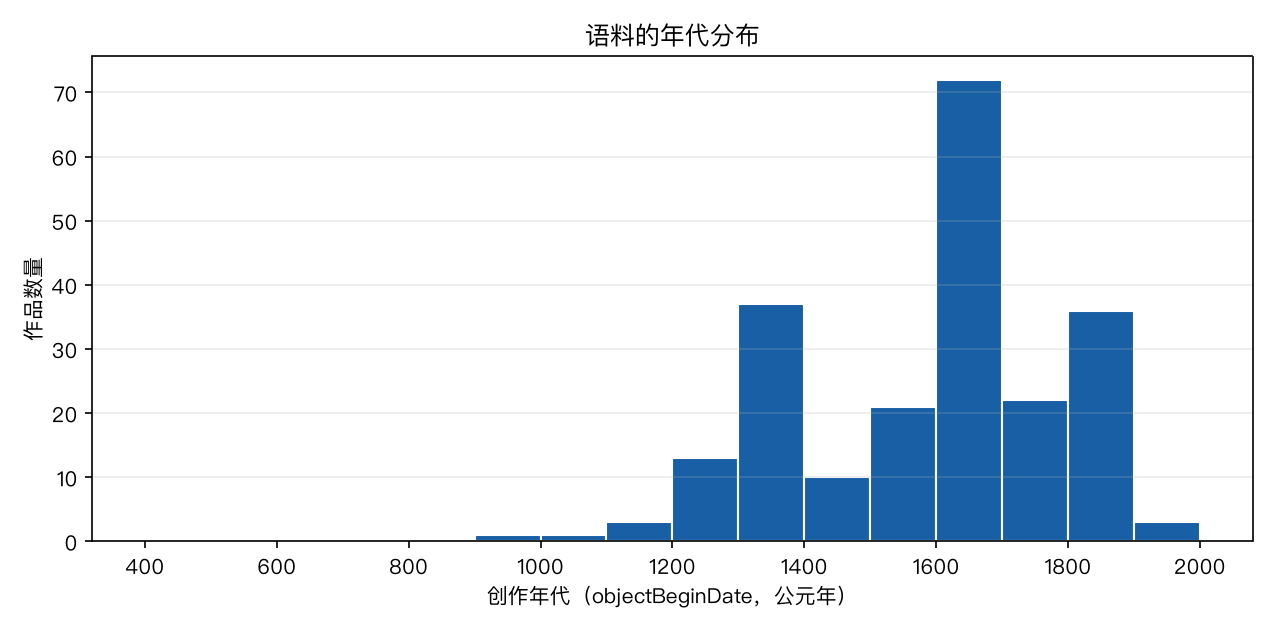
A collection's century profile is an institutional fact before it is an art-historical one.
Split by century, the corpus peaks sharply in the 1600s, with 72 works, then a second band in the 1300s (37) and the 1800s (36). This is a map of what the Met holds — and of what one open-access search returned — not of how much painting was actually made. Read it as a portrait of an institution's collecting, not of a tradition's output.
2 Six colour clusters
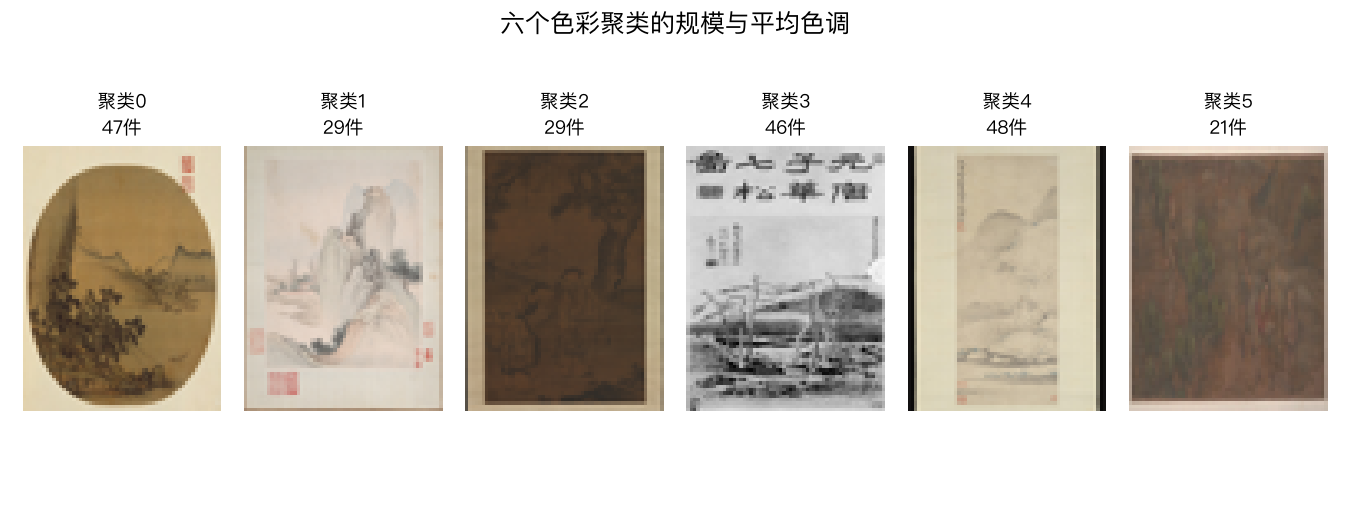
Grouped by colour alone, the works fall into six uneven families.
Reducing each image to a 64-bin colour histogram and clustering gives six groups of strikingly unequal size — 48, 47, 46, 29, 29 and 21 works. Look at representative pictures and the groups are not "styles": they separate dark album leaves, pale silk, monochrome ink, gold-toned fans, and so on. The machine's first cut is material, not period.
3 The colour space
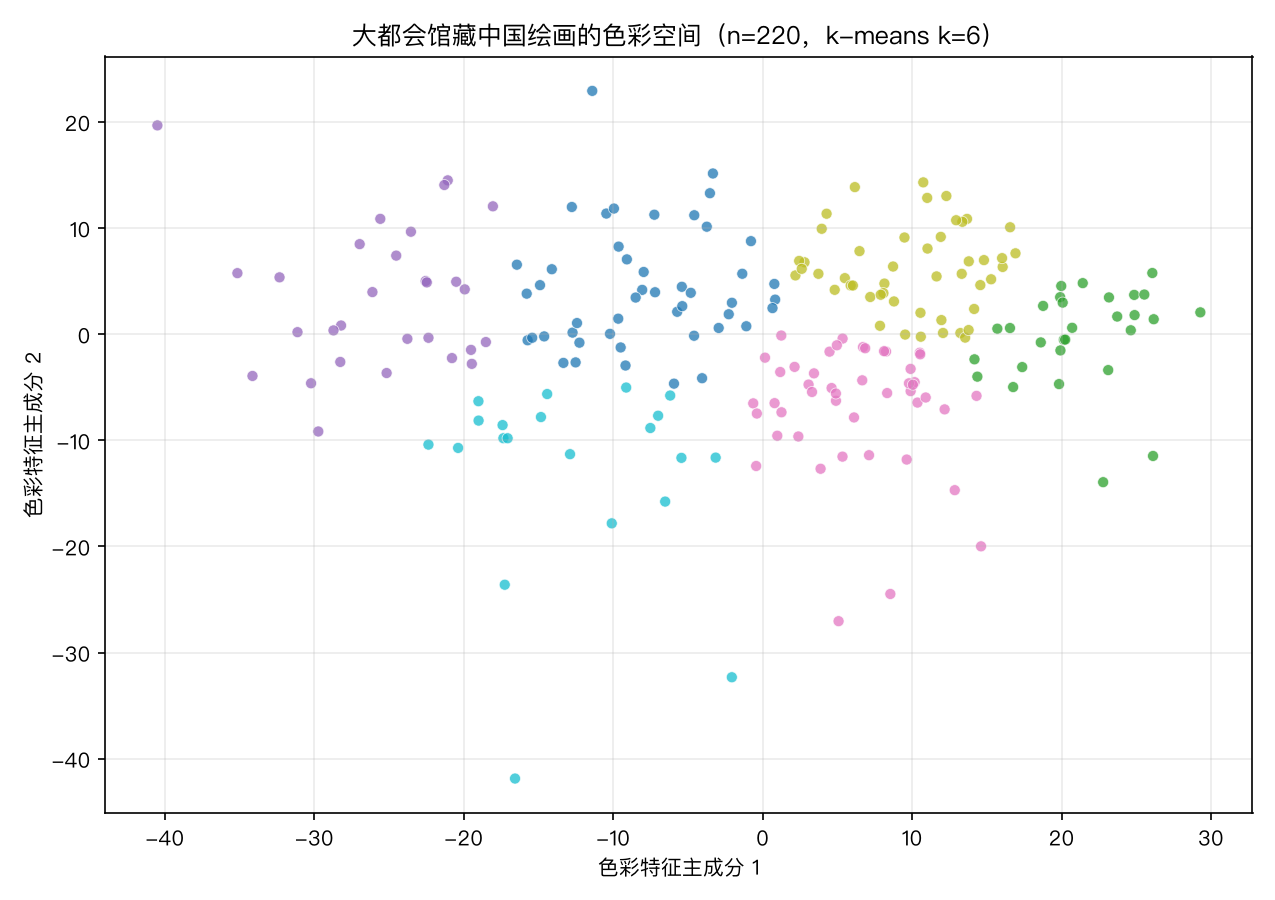
Projected onto two axes, the works fan out by colour — not by date.
On two principal components of the colour features, the works spread into loose, overlapping groups rather than neat dynasty blocks. Proximity here means a similar palette and tonality in the photograph, which is a far cry from a shared school or period.
4 Brightness, saturation — and time
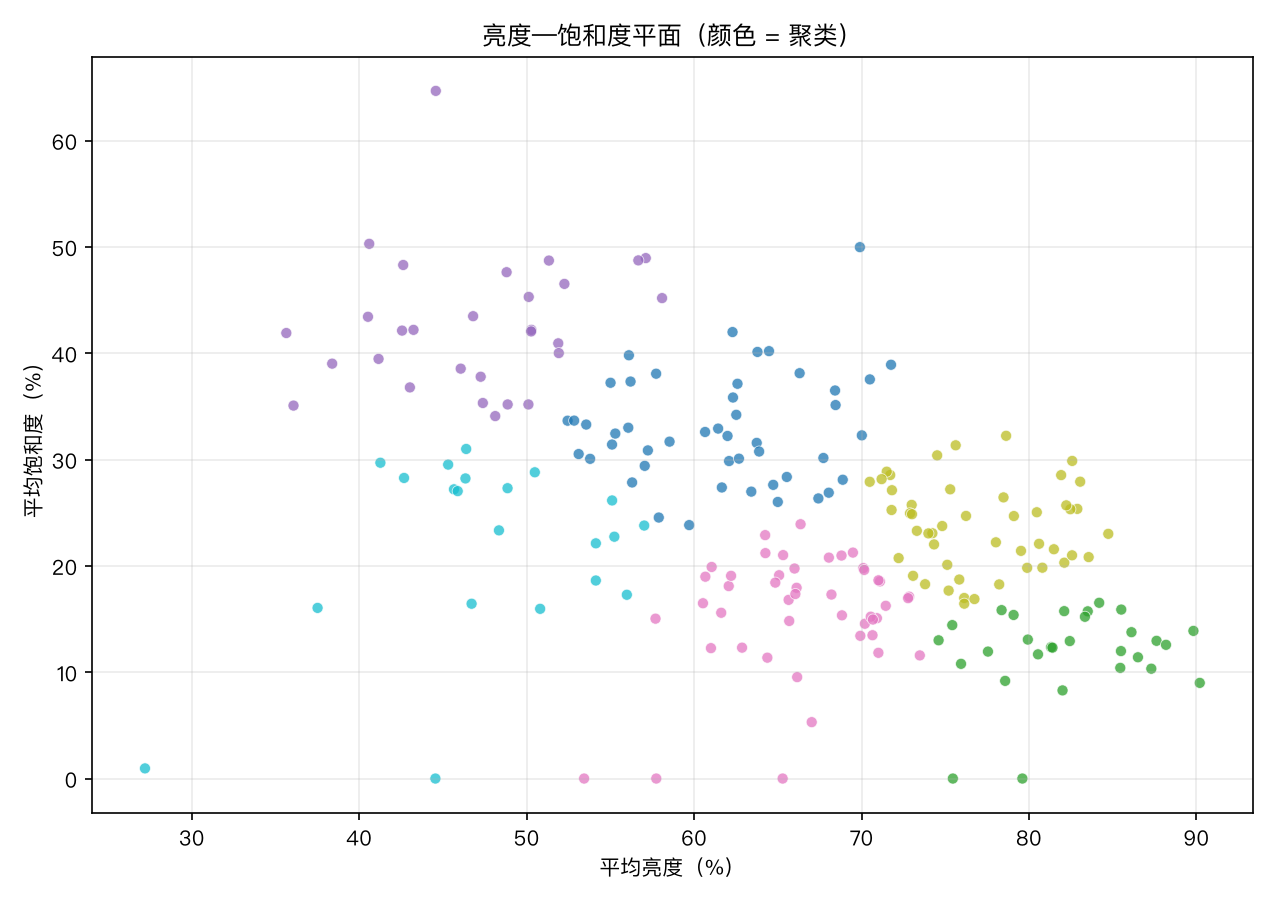
Clusters track medium and support; over time, pictures get lighter.
In the brightness–saturation plane the clusters occupy distinct zones, tracking medium and support more than date. A modest but real trend also appears across time: later works tend to be brighter (r = 0.42, n = 218). Whether that is pigment, paper, or simply the photography is exactly the kind of question that metadata alone cannot settle — and the kind worth asking next.
How to read this — and what it doesn't say
- The machine reads a photograph of a work, not the work itself; white balance, exposure, and the oxidation of silk all shift the numbers.
- Features are a 64-bin colour histogram plus mean brightness and saturation; clustering is K-means (k = 6), PCA is for display only.
- The corpus is the 220 works returned by one open-access search for Chinese painting — a sample shaped by the collection and the query, not a census.
- Source data is CC0. This is an independent, non-official reading and does not represent the Met's own interpretation.
Open the interactive explorer ↗
Hover any dot to see the work; click through to the Met's catalogue.