Lab · Form experiment · 2026 / 11
One grammar,
three objects
A stained-glass window, a rotatable cloisonné column and a design object — read as three independent made things.
An interpretive experiment in visual form. Not a reconstruction, and no provenance claim is made.
Enter the three-state plate →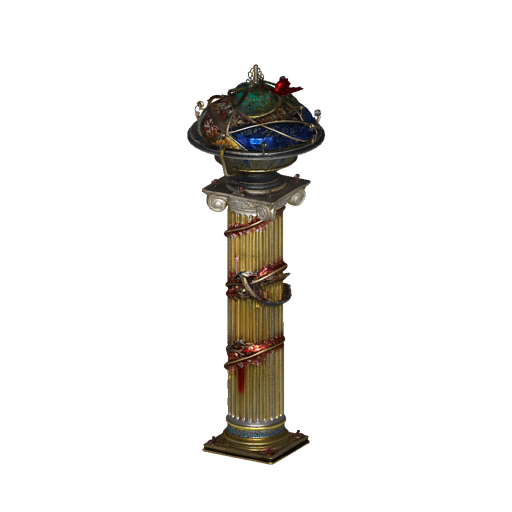
Interactive 3D is unavailable on this device — a static catalogue render is shown.
A stained-glass window, an AI-generated cloisonné column and a design-speculation still life are read side by side. Not as three stages of one artefact, but as three made objects that handle the same formal grammar differently — and so make visible what cultural activation keeps, bends and invents.
以一扇彩窗、一件 AI 生成的珐琅柱、一张文创陈设海报为三件独立的物,比较同一套形式语法在它们之中如何被保留、变形与新增。这不是复原,也不主张三件物之间存在谱系承继。
No provenance claim is made. Harry Clarke's Four Orders window is the point of departure for a reading, not a source that the model or the poster reproduces.
Open the interactive plate → Method & sources
1 What is being compared
Seven formal categories, not seven motifs with a shared history.
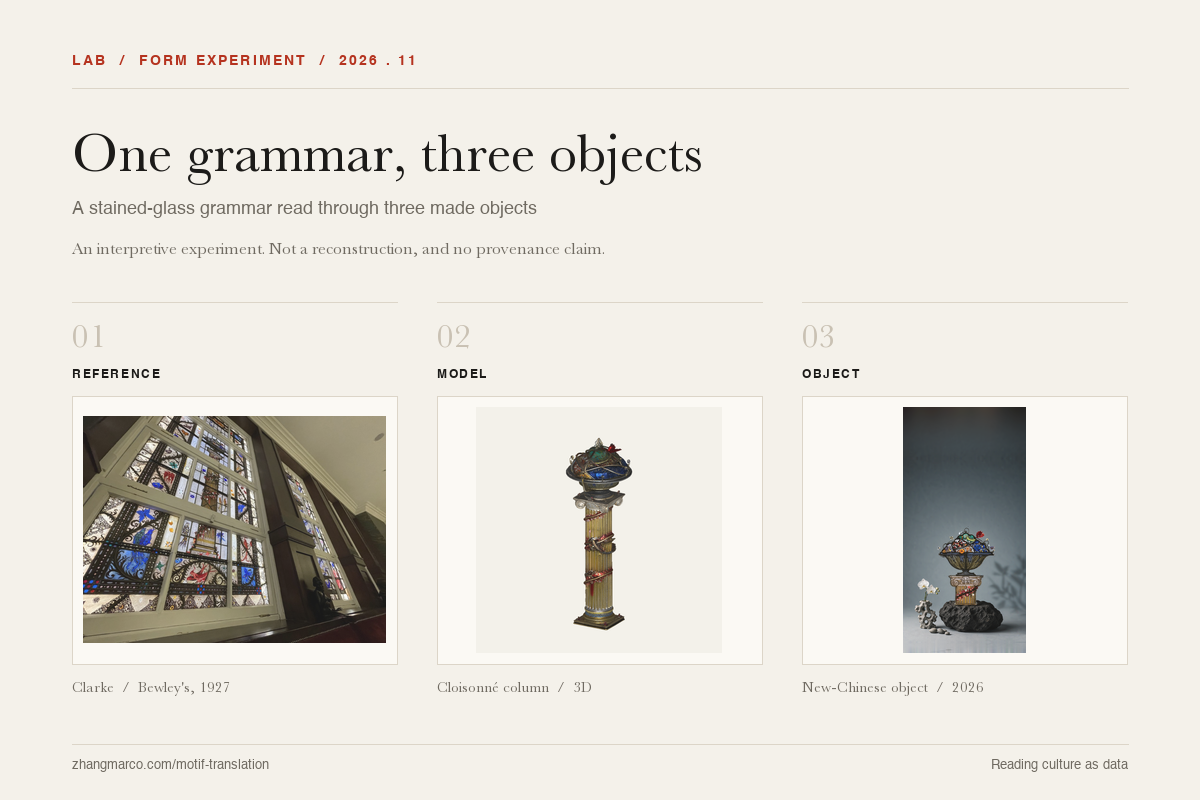
The three objects have no documented relation to one another. The window is a 1927 fixture in a Dublin café; the column and the poster are both AI-generated artefacts made in 2026 from text prompts and reference images. Reading them as "original → model → product" would imply a provenance that does not exist.
What can be compared is grammar: a small set of formal categories — the classical order, the fluted shaft, the capital, the translucent field, botanical ornament, the bowl-shaped crown, and light. Each is scored in each object as retained, transformed, introduced or absent. The scoring is an interpretive judgement by the author, not a measurement.
Scoring is the author's reading of form. The full text behind each cell is in the interactive plate.
2 Reading the three states
A window, a model, and an object.
The window
Harry Clarke's Four Orders window (Bewley's Café, Grafton Street, 1927) sets classical columns inside a leaded glass wall. Native foliage, birds and vines are worked into the imperial frame; the lead lines are hidden inside the ornament. Colour here is transmitted, not reflected — the window only becomes itself when daylight passes through it.
The column
An AI-generated cloisonné column: gold fluted shaft, red garlands at four heights, a domed multicolour finial. The material has changed from glass to enamel and gilt metal, so colour is now reflected. Four orders collapse into one; the model is freely rotatable, which is precisely what a window fixed in a façade can never be.
The object
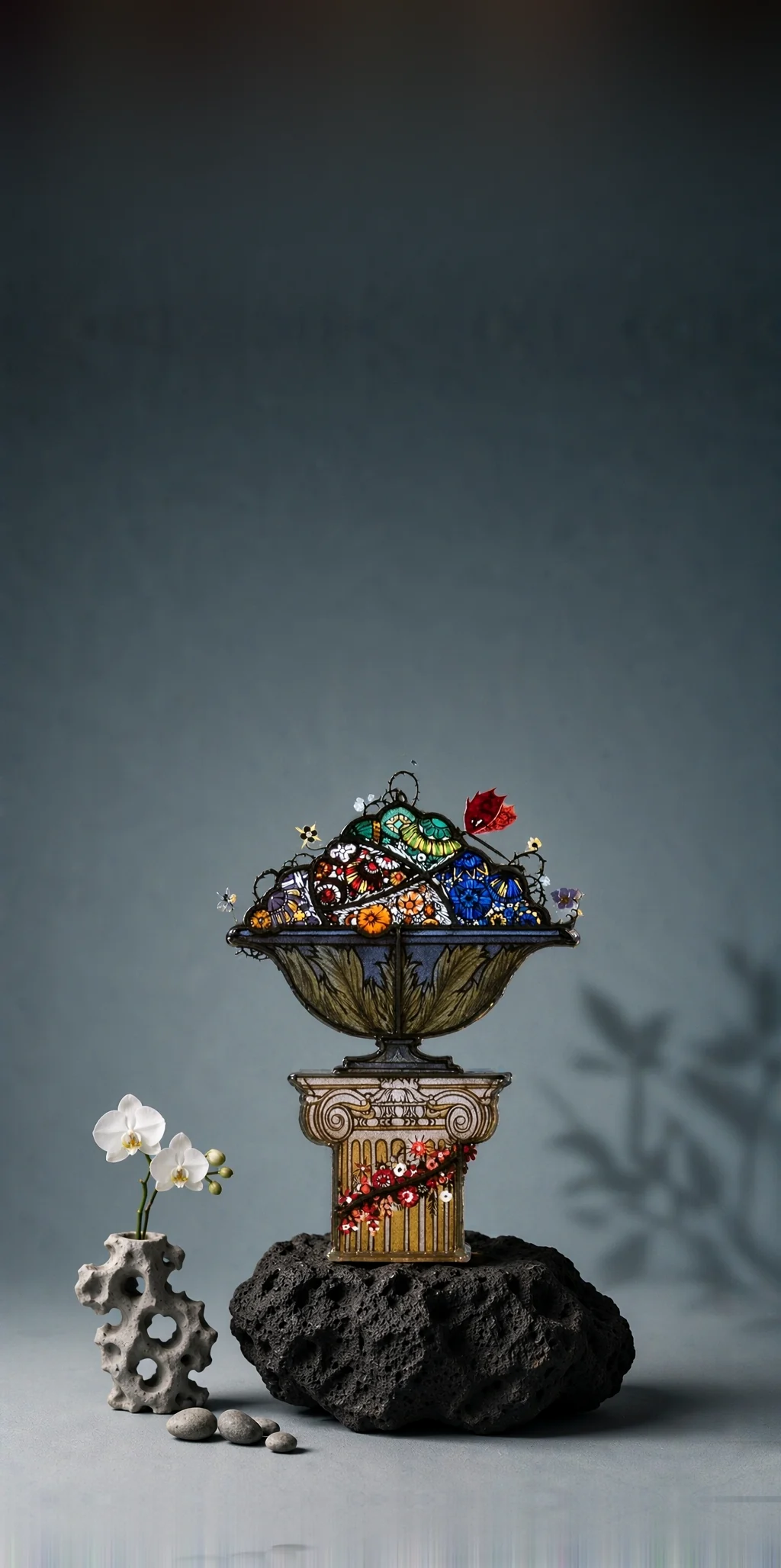
An AI-generated still life restages the capital as a scholar's object on volcanic rock, with an orchid, a pierced Taihu stone and a bamboo shadow. These are new additions with no precedent in the window. The bowl keeps its stained glass, but the whole is now a photographed surface under studio light.
The two generated states at full size. They were produced independently; neither is derived from the other.

3 What the comparison shows
Three findings, all about form rather than origin.
The most stable unit is the least classical one. The urn or bowl-shaped crown is the only category retained in all three states. The fluted shaft and the volute capital survive too, but are compressed or restated. What travels best across media is not the classical canon but the vessel that sits on top of it.
The cost of becoming an object is light. In both generated states, transmitted light is absent: backlighting gives way to studio illumination, and a light-bearing architectural surface becomes a reflective thing on a plinth. This is a material change, and it is the clearest single difference between the window and its derivatives.
New botany is the signature of activation — and of its limits. Orchid, Taihu stone and bamboo shadow are introduced in the third state. They make the object legible within a new-Chinese visual code, but they are the elements least traceable to Clarke. Cultural activation becomes most visible exactly where documentary accountability becomes weakest.
Reading note · 读法说明
- These are three made objects, not three phases of one object, and no stylistic descent is claimed.
- The 3D column and the poster are AI-generated. Neither is a reconstruction, a facsimile, nor evidence about the historical window.
- Markers on the interactive plate indicate formal categories, not measured positions on the object.
4 Method
Every state has a reproducible production record.
01 · Source photograph. The Four Orders detail was photographed by the author on site (original HEIC, exported at 900×675). It is a partial view of the window wall: the full run of windows cannot be captured in one frame from inside the café. Clarke's designs are out of copyright; the photograph carries its own copyright and is used here by the author.
02 · 3D model. A material-preview prompt produced an OBJ mesh with four PBR texture maps, assembled into a 78 MB GLB. For the web, the albedo and normal maps were kept at 4096² and converted to WebP (normal q95, others q90; metallic–roughness reduced to 2048²), the mesh simplified to 60% at error 0.0001, and positions quantised with KHR_mesh_quantization. The published GLB is 17.68 MiB and needs no external decoder: an earlier Meshopt build was discarded because the bundled viewer does not register a Meshopt decoder. All assets are self-hosted; no CDN requests.
03 · Object plate. Generated with an image model (hy-image) through ten prompt iterations (prompt_v2 → prompt_v10), constrained by a written product-identity fidelity checklist and recorded in params.json. Canvas extension and recomposition were scripted (extend_canvas_v10.py, recomposite_v9*.py); the final 1024×2056 PNG is published as a 122 KB WebP. The orchid, Taihu stone and bamboo shadow are scene additions specified in the prompt, not recovered from the window.
Annotation. Seven formal categories and their four-state scoring were defined by the author after the three objects existed. The same seven numbered anchors are reused across all three states in the interactive plate; their positions are indicative, adjusted by eye for each composition.
5 Sources and credits
Each visual asset, with its status.
Four Orders window photograph. Harry Clarke, Bewley's Café, Grafton Street, Dublin, 1927. Photograph © Marco Zexun Zhang, used by the author. A second figure-window photograph from Wikimedia Commons is CC BY-SA 4.0; its author attribution is still to be verified from the file page and it is not reproduced in this experiment.
Cloisonné column, 3D. AI-generated mesh and PBR texture set, 2026; composition, prompt and web optimisation by the author. Not a depiction of a museum object. Viewer: model-viewer (Apache-2.0), self-hosted.
New-Chinese object plate. AI-generated image, 2026; prompt iterations, fidelity checklist, recomposition scripts and final layout by the author. Reference imagery: the model render and the author's own window photograph.
Historical framing. The description of the Four Orders window follows published accounts of Harry Clarke's Bewley's commission and the café's Grafton Street interior. The 2022 High Court dispute over whether the windows are fixtures is a matter of public record; it is context for the heritage reading, not a source for any figure here.
6 Limits
Not a reconstruction. Nothing on this page claims that the column or the poster reproduces a historical object, follows Clarke's working method, or descends from the window. The three are independent artefacts brought together for a formal comparison.
Generated content is not visual evidence. Both generated states may contain invented ornament, impossible material transitions and anachronistic combinations. The fidelity checklist is an internal production document, not third-party authentication. None of the generated imagery should be cited as documentation of the Bewley's windows, of cloisonné technique, or of any collection.
The source is a partial view. The photograph shows part of the window wall at an angle; several categories (notably light and the classical sequence) are read from published descriptions as much as from the frame. The Commons figure-window photograph is not used here because its author credit has not yet been confirmed.
The scoring is interpretive. "Retained", "transformed", "introduced" and "absent" are the author's formal judgements, not measurements, and a different category scheme would produce a different plate. Marker positions are indicative and were placed by eye, not by image registration.
Technical limits. The interactive model is 17.68 MiB and is loaded only when the Column state is opened. On slow connections and small screens it remains heavy; where WebGL or the viewer is unavailable the plate falls back to a static catalogue render, and the case study above is the durable record.
7 Credits and licence
Concept, annotation, photograph, prompt work and web build: Marco Zexun Zhang. An independent, non-official interpretive experiment; not affiliated with or endorsed by Bewley's, the Arts Council, or any museum. Clarke's designs are out of copyright; the author's photograph and all original annotation on this site remain © the author. The AI-generated 3D mesh and poster are published here as documentation of a method, with no claim of exclusive rights over the underlying generated forms.