M+ Collection · Case study
Sigg Collection vs. the M+ Collection
The Sigg Collection is often described as a window onto Chinese contemporary art. Placed beside the full M+ collection, the numbers show something sharper — a focused institutional lens, not a miniature of the whole.
1 Era
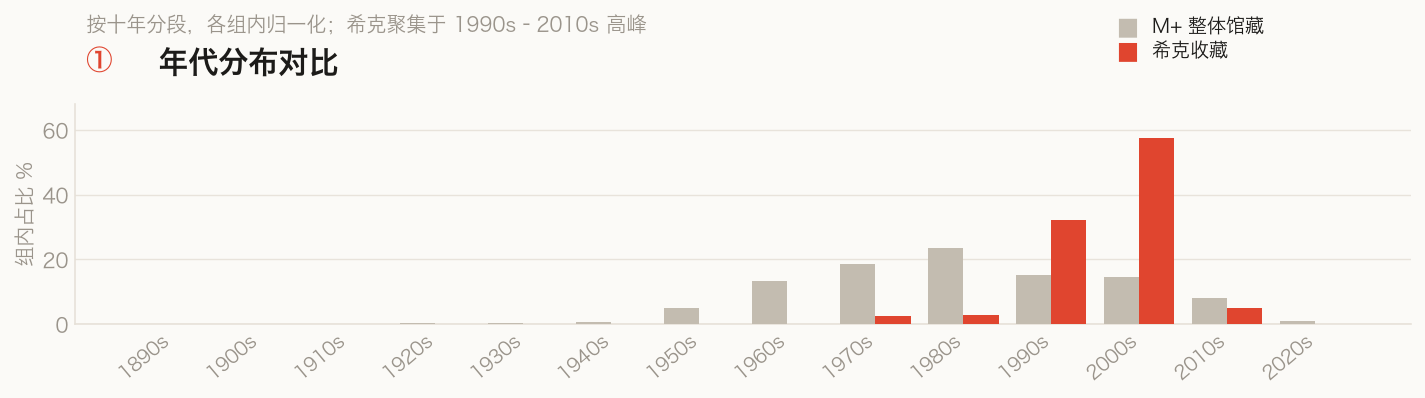
Decade by decade — Sigg clusters in the 1990s–2010s.
Split by decade, the two collections diverge almost immediately. The full collection is spread broadly across the twentieth century, with steady weight from the 1950s onward. The Sigg works, by contrast, concentrate hard in a single band — peaking around the 2000s — which is exactly what a collection assembled around a living scene looks like.
2 Category
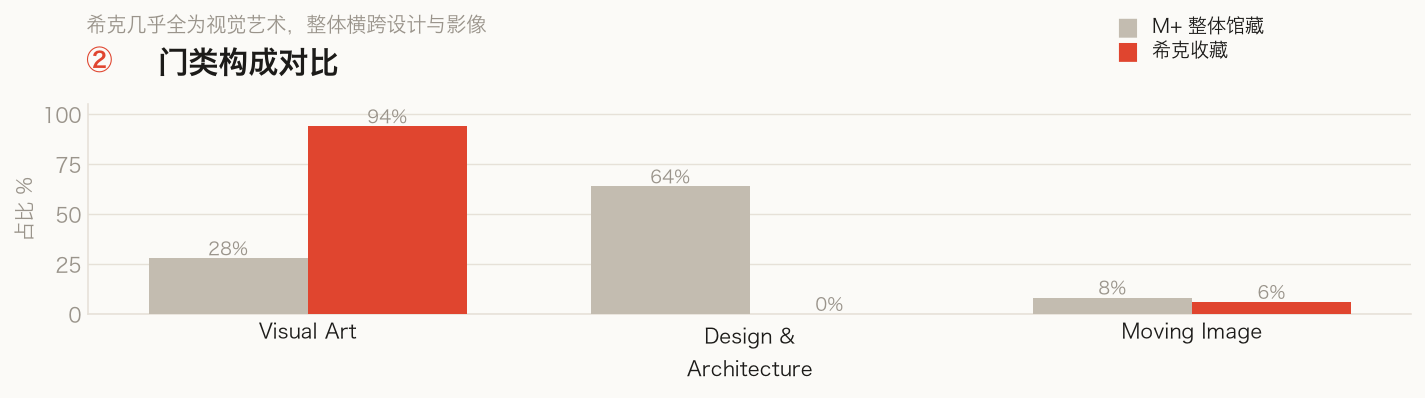
Sigg is almost purely visual art; the whole collection is not.
This is the clearest structural difference. Visual art makes up 94% of the Sigg works but only 28% of the collection, where design and architecture dominate at roughly 64%, with moving image at about 8%. A single donor's taste narrows the field; an institution's remit widens it.
3 Medium
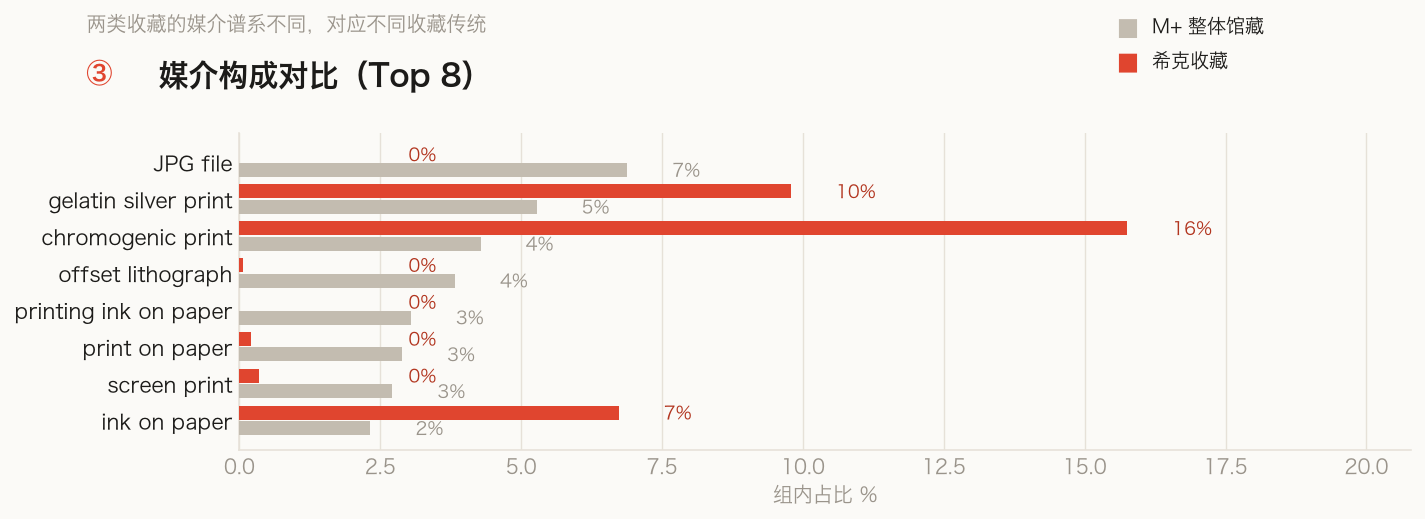
Two media traditions, two different stories about collecting.
The top media tell their own story: the Sigg works lean heavily on chromogenic prints, while the broader collection carries a much denser print tradition — gelatin silver, offset lithography, and ink on paper. Medium is where abstract categories turn back into concrete objects.
4 Nationality
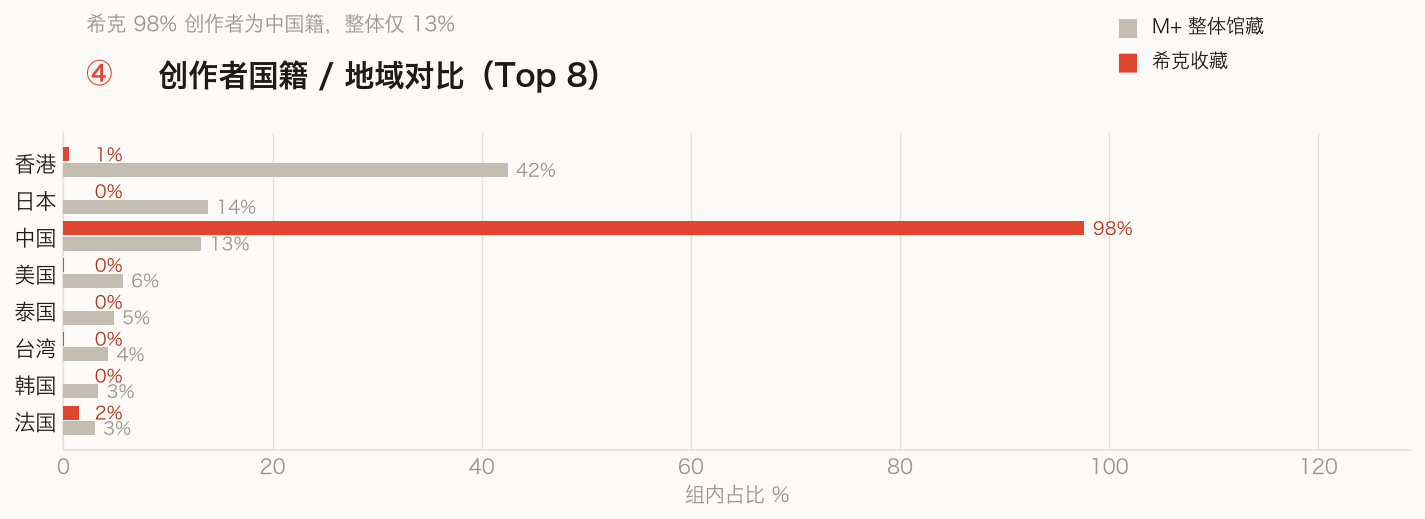
A China-focused lens, against a globally diverse collection.
Nationality makes the frame explicit. Among Sigg creators, 98% are Chinese; across the whole collection the largest single group is Hong Kong at about 42%, with China at 13% and Japan at 14%. Read together, the comparison is not "the collection is Chinese" but "the Sigg donation is a China-focused lens inside a deliberately global collection."
How to read this — and what it doesn't say
- This analysis reads institutional metadata, not the artworks' images or their visual content.
- Nationality is taken from the first-listed creator; multi-author and collective works are simplified.
- The Sigg Collection is a single donation — one collector's lens, not "Chinese art" as a whole.
- Source data is CC0. This is an independent, non-official reading and does not represent M+'s own interpretation.
Open the interactive explorer ↗
The explorer lets you filter and compare the two collections yourself.